So, how is riding an e-bike different from riding a regular bicycle? The short answer: six specific ways. Pedal assist changes your effort level, speed arrives faster than you expect, the extra weight shifts how you handle the bike, braking takes more runway, fitness returns are real but lower per ride, and battery range adds a planning variable that a regular bike never did. These aren’t cosmetic differences. Each one changes how you prepare, how you ride, and how you stop.
A lot of first-time e-bike riders assume an e-bike is basically a regular bike with a battery bolted on. After about five minutes on the trail, that assumption gets corrected fast. Here’s exactly what changes, and what it means for how you ride.
Key takeaways
- Pedal assist amplifies you: The motor adds power on top of your effort; it doesn’t replace it. Sensor type determines how natural that feel is.
- Speed sneaks up on you: On a Class 1 e-bike, many riders reach 20 mph on an upright frame with far less effort than on a road bike, which makes speed feel surprisingly sudden.
- Weight is invisible until it isn’t: Motor assist masks the extra pounds while riding, but you’ll notice them at low speed and when pushing by hand.
- Brake earlier, always: More mass plus higher speed means more momentum to scrub. Start slowing down before it feels necessary.
- You still get a workout: E-bike riding qualifies as moderate-intensity exercise; you just burn fewer calories per hour than on a regular bike at the same speed.
- Plan around battery range: Use 60–70% of the advertised max range for flat-to-mixed rides, and always reserve 10–15% at the end.
1. Pedal assist: the fundamental difference you feel from the first push
Pedal assist doesn’t do the work for you. It detects that you’re pedaling and layers motor power on top of your own effort. The sensor type under the hood determines how natural that partnership feels. Cadence sensors detect whether the cranks are turning and deliver a preset power level, which can feel like a sudden shove. Torque sensors measure how hard you’re actually pushing and respond proportionally, so the assistance rises and falls with your effort, like having stronger legs. This is why two e-bikes at a similar price point can feel completely different the moment you start pedaling.
Your assist level doesn’t set a speed. It sets how much motor power is available. In Eco mode, you’re contributing more effort, your battery lasts longer, and acceleration is gentler. In Turbo mode, the motor carries a bigger share of the load, hills feel flat, and starts feel almost effortless. The part most new riders miss: you can hit the same speed at any assist level. The difference is how hard you’re working to get there. Wind, terrain, rider weight, gearing, and tire pressure all still play a role. The motor changes the equation, not the physics.
2. Speed: how is riding an e-bike different from riding a regular bicycle at pace?
E-bikes fall into three classes in the United States, and the class determines how fast the motor will help you go. The motor stops assisting at the class limit, but the bike can still exceed that speed from rider effort or downhill momentum, a detail that surprises a lot of new riders. It also means the distinction between an assisted bicycle and a manual bicycle is very real once you’re moving at pace.
| Class | Motor operation | Maximum motor-assisted speed |
|---|---|---|
| Class 1 | Pedal assist only; no throttle | 20 mph |
| Class 2 | Pedal assist plus throttle | 20 mph |
| Class 3 | Pedal assist only | 28 mph |
Twenty miles per hour on an e-bike doesn’t feel like 20 mph on a road bike. On a conventional bicycle, reaching that speed typically requires a more aerodynamic position and significantly more sustained effort. On a Class 1 e-bike, many riders reach 20 mph on an upright hybrid frame in jeans, barely breathing hard. That gap in perceived effort is exactly why new riders consistently underestimate how fast they’re actually moving. When you’re on a pre-mapped route with known landmarks and turn-by-turn guidance, the kind we design at Fun E-Bike Adventures to reduce navigation stress, you can focus on the ride rather than a speedometer doing something unexpected.
3. Weight and handling: why an e-bike feels different in tight turns
A typical commuter e-bike weighs 50–60 lb. A standard commuter bicycle weighs 25–30 lb. That’s roughly double the weight, and it matters in ways that aren’t always obvious until you’re on the bike. The motor assist masks the extra mass beautifully while you’re pedaling at a normal pace. The added weight becomes obvious the moment you try to push the bike by hand, lift it over a curb, or navigate a slow tight turn through a parking area.
At cruising speed, that extra weight actually works in your favor. A heavier e-bike feels planted, tracks straighter over rough surfaces, and doesn’t get tossed around in crosswinds the way a lightweight road bike does. The tradeoff shows up in nimbleness: initiating a turn takes a bit more deliberate input, and sudden direction changes at speed require more commitment. Riders coming from lightweight road bikes often describe the first few e-bike rides as “heavy to steer” before they recalibrate. Most riders report feeling comfortable with the handling after a few outings, though your timeline will vary.
4. Braking: why you need to start stopping earlier on an e-bike
This is the difference most new riders learn the hard way. At 20 mph, more total mass means significantly more momentum than the same speed on a lighter regular bike. The brakes have to dissipate all of that extra energy. At 20 mph on dry pavement, a regular bike typically stops in roughly 18–25 feet. An e-bike at the same speed needs approximately 25–40 feet. That 7–15 foot gap doesn’t sound catastrophic until a pedestrian steps off the curb or traffic stops suddenly.
Most quality e-bikes use hydraulic disc brakes with larger rotors than you’d find on a comparable regular bike, specifically to handle the extra braking load. The hardware is genuinely capable. What the hardware can’t fix is a rider who brakes too late. The practical rule is simple: always brake before a turn, never during it. Start slowing down earlier than feels necessary, especially downhill or with cargo on the bike. Maintaining greater following distance than you would on a regular bike isn’t overcaution, it’s just physics applied to momentum.
5. Fitness and effort: do you still get a workout on an e-bike vs. a regular bicycle?
Yes, you get a workout. The numbers are just lower than a regular bike at the same speed. Studies such as the controlled comparison published in the Translational Journal of the American College of Sports Medicine put regular cycling at roughly 450–560 calories per hour at moderate effort. E-bike riding at low assist produces about 350–450 calories per hour; at high assist, that drops to around 200–300 calories per hour. Heart rate runs about 11 beats per minute lower on average, though research also shows e-bike riders commonly reach 67–79% of maximum heart rate even with assist engaged, which qualifies as moderate-intensity exercise by any reasonable standard.
| Ride type | Approximate calories/hour | Cardiovascular load |
|---|---|---|
| Regular bicycle | 450–560 kcal | ~66% max heart rate |
| E-bike, low assist | 350–450 kcal | ~62% max heart rate |
| E-bike, high/turbo assist | 200–300 kcal | ~56% max heart rate |
The counterintuitive part: e-bike riders often accumulate more total weekly exercise than regular cyclists, not less. Because the rides are easier and more enjoyable, people do them more frequently, go farther, and tackle routes they’d skip on a conventional bike. The lower perceived effort also brings in riders who’d otherwise stay home due to hills, heat, or fitness level. At Fun E-Bike Adventures, our routes are mapped with known distances and elevation so you can match your outing to your starting energy level instead of guessing at a trailhead.
6. Battery range vs. pedaling as far as your legs allow
A regular bike has effectively unlimited range: you stop when your legs give out. An e-bike adds a battery to that equation, and that battery’s real-world range is almost always different from the number on the spec sheet. For a 500 Wh battery on mixed terrain with a rider in the 160–200 lb range, here’s what realistic range actually looks like.
| Assist setting | Approximate consumption | Realistic range |
|---|---|---|
| Eco / Level 1 | 8–12 Wh/mi | 40–60 miles |
| Tour / Level 2 | 12–18 Wh/mi | 28–42 miles |
| Sport / Level 3 | 18–25 Wh/mi | 20–28 miles |
| Turbo / Boost | 25–40 Wh/mi | 13–20 miles |
Add hills, cold weather, cargo, underinflated tires, or a rider above 220 lbs, and those numbers can drop another 15–35%. The practical planning rule that experienced e-bike riders follow: use 60–70% of the advertised max range for flat-to-mixed terrain, and drop to 35–50% if the route has significant climbing or cold conditions. Always reserve 10–15% battery at the end rather than planning to roll in at zero. This is exactly why knowing your total route mileage before you leave matters so much. Doing range math while staring at an 8% battery indicator and a trailhead sign is not the vibe you want.
Which bike is right for you, and how to make the transition smoothly
If you’re still wondering how riding an e-bike is different from riding a regular bicycle, these six points cover what to expect: pedal assist changes your effort, speed happens faster than you expect, weight affects low-speed handling in ways the motor doesn’t mask, braking needs earlier input, fitness returns are real but lower per ride, and battery range requires trip planning that a conventional bike never demanded. Every one of these differences is learnable, usually within a few rides. None of them should stop you.
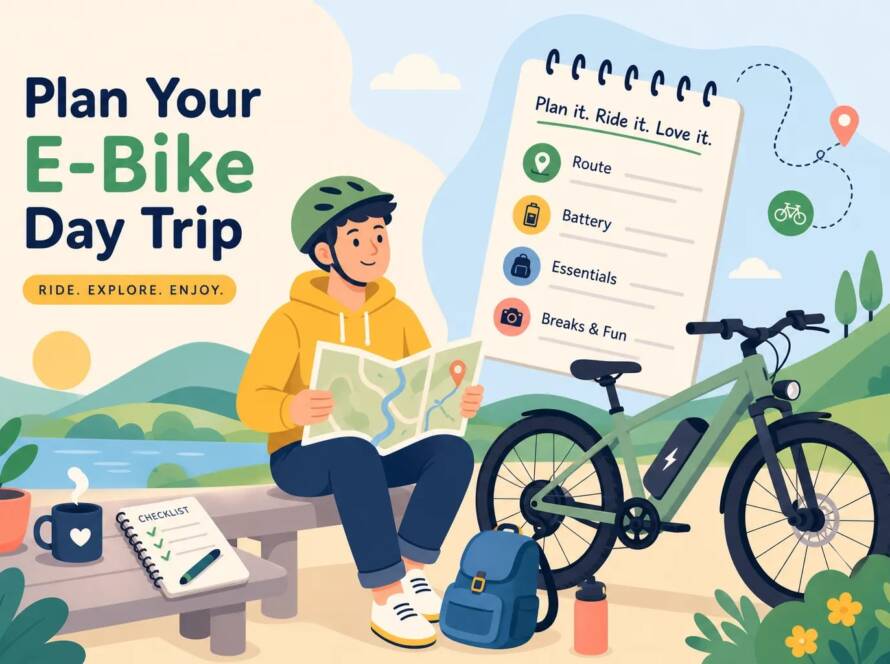
The fastest way to build confidence is to know your route before you leave: total mileage, terrain, turnaround point, and whether there’s somewhere to stop along the way. That’s exactly what we build into every GPS-guided adventure at Fun E-Bike Adventures. Each route is personally scouted and ridden by our founder, mapped with turn-by-turn accuracy on the Ride with GPS platform, and priced under $6 with no expiration on your download. You focus on getting comfortable with the bike; we handle the navigation.
Whether you’re switching from a regular bike or picking up two wheels for the first time, knowing these six differences puts you three rides ahead of figuring it out the hard way. The e-bike isn’t just a bike with a battery. It’s a genuinely different machine, and once you understand how it works, it’s also a genuinely better way to explore.
Frequently Asked Questions
How should we plan a route for an e-bike ride?
Plan your route by knowing total mileage, terrain, a turnaround point, and whether there are places to stop along the way. Use realistic range figures, expect 60–70% of advertised max range on flat-to-mixed routes and always reserve 10–15% battery at the end, so you don’t run low mid-ride.
How long will it take us to get comfortable riding an e-bike?
Most riders feel comfortable after a few outings and often within about three rides ahead of figuring things out the hard way. The motor masks weight at speed, but low-speed handling and braking habits settle quickly with practice.
Will an e-bike still give us a real workout?
Yes, e-bike riding qualifies as moderate-intensity exercise, though you burn fewer calories per hour at the same speed compared with a regular bike. Depending on assist level, expect roughly 350–450 kcal/hour at low assist and 200–300 kcal/hour at high assist, with heart rates running lower on average but still in the moderate-intensity range.
How do different sensor types affect how natural the e-bike feels when we pedal?
Sensor type determines how the motor partners with your pedaling: cadence sensors deliver a preset power when the cranks turn and can feel like a sudden shove, while torque sensors scale assistance to how hard you push for a more proportional, natural feel. That difference explains why similarly priced e-bikes can feel completely different the moment you start pedaling.