What does it mean to ride a bike predictively, and why does it matter? Put simply, predictive cycling means reading the road or trail ahead and adjusting your speed, position, or line before a hazard forces your hand. Not after the dog darts into the path. Not after the gravel patch sends your front wheel sideways. Before. It is the difference between riders who seem impossibly smooth and riders who spend every ride white-knuckling their brakes.
Many riders default to reactive riding without realizing it. They focus on what is directly in front of the wheel, respond to problems as they arrive, and chalk up every near-miss to bad luck. For e-bike riders, that approach is especially risky: higher average speeds, heavier bikes, and longer stopping distances mean the cost of being caught off guard is steeper than it is on a standard bicycle. The good news is that anticipatory riding is a learnable skill, not a talent you either have or don’t.
Key takeaways
- Predictive vs. reactive: Predictive cycling adjusts early and smoothly; reactive riding brakes or swerves when a hazard is already urgent.
- The core loop: The SIPDE framework (search, identify, predict, decide, execute) runs continuously the entire ride, not just at tricky spots.
- Visual lead time: Aim for 10 to 15 seconds of scan distance ahead in normal conditions, farther at higher e-bike speeds.
- Six key techniques: Scanning distance, gap selection, road positioning, speed control, escape route planning, and predictable signaling work together as a system.
- Terrain changes the target: Urban riding predicts human decisions; suburban riding predicts hidden conflicts; trail riding predicts what the surface will do to your bike.
- Drills build the habit: Practice the 20-second hazard scan, commentary rides, and cornering circuits in low-stakes settings before bringing the skill into real traffic.
What does it mean to ride a bike predictively? Predictive vs. reactive riding explained
Predictive riding continuously scans ahead, forecasts what may happen, and makes early, smooth adjustments. Reactive riding waits until a conflict is immediate, then brakes hard or swerves. The gap between those two modes is not reflex speed; it is where your attention is focused before anything goes wrong.
Picture a trail approaching a blind bend. A family of hikers is just out of sight around the corner. The anticipatory rider lifts off the pedals well before the bend, claims the outside line, and rolls through at a speed that gives everyone room to react, an illustrative distance that will vary with speed, visibility, and trail conditions. The reactive rider discovers the problem at arm’s length and grabs the brakes. Same trail, same hazard, completely different experience.
The scan-predict-act loop every confident rider runs
The mental framework behind anticipatory riding is often called SIPDE: search, identify, predict, decide, execute. You scan the environment, pick out what could become a hazard, forecast its likely movement, choose your response, and act on it smoothly. Then the loop restarts immediately. It is not a checklist you run once at the trailhead; it is a repeating mental cycle that runs from the moment you push off to the moment you stop.
Breaking the loop is exactly what gets riders into trouble. Fixate on one vehicle for too long, and you stop seeing the pedestrian stepping off the curb on the right. Rush the “predict” step, and you commit to a gap that is already closing. The framework keeps your awareness distributed rather than locked on a single point.
Why reactive riders always feel one second behind
The cognitive problem with reactive riding is timing. By the time a hazard is visible, registered, and communicated to your hands and feet, the window for a controlled response is already shrinking. A hazard-prediction study of Chinese cyclists (Development of a Hazard Prediction Test for Chinese Cyclists, available via NCBI) found that crash-involved riders consistently scored lower on hazard-prediction tests than non-crash-involved cyclists, with a meaningful association between lower prediction ability and higher crash involvement. That is not a coincidence; it is what a one-second delay looks like in the data.
On an e-bike traveling at 25 km/h, your reaction time alone can consume roughly 5.6 meters before braking even begins, based on reaction-time distance calculations from e-bike safety research. Add braking distance and you are looking at a substantial gap between “I see the problem” and “I have stopped.” Anticipatory riding buys back that gap before you need it.
What your eyes should actually be doing while you ride
Most riders stare at the patch of trail directly in front of their wheel. That is exactly backwards from how anticipatory riding works. Your eyes should be well ahead of your bike, feeding your brain a preview of what is coming so your hands and feet can respond early and calmly.
The target in normal conditions is roughly 10 to 15 seconds of visual lead time. At a casual 12 mph, that translates to about 175 feet ahead, roughly half a city block. For e-bike speeds around 25 km/h, practical guidance suggests a minimum of 20 to 30 meters (roughly 65 to 100 feet), and farther still near junctions, blind bends, and high-traffic zones. Think of the time-based target as the general rule and the distance figure as its real-world translation for typical e-bike paces.
How far ahead to look (and why close-staring gets people hurt)
At that scanning distance, you are not looking for one specific thing; you are reading a scene. Vehicle wheel positions tell you whether a car is tracking straight or drifting toward a turn. Pedestrian body language tells you whether someone is about to step left or stay put. Surface texture changes tell you whether the next 20 meters are going to grip or slide. An object that has not moved but is positioned where things cross tells you to be ready for it to move.
Close-staring shrinks your reaction window to almost nothing. When your gaze is fixed five feet ahead of your front wheel, you are processing information at the same moment you need to respond to it. That is not riding; that is controlled panic.
The repeating eye pattern that keeps your situational awareness on a bike locked in
A default scan sequence looks like this: far ahead, immediate path surface, sides and cross-traffic, behind (or mirror check), escape route, then repeat. The pattern is not rigid; it adjusts to the environment. Narrow trail with low traffic? Less time checking behind, more time reading the surface. Urban intersection? More time on vehicle wheel positions and pedestrian movement.
The value of having a default loop is that it prevents fixation. When something grabs your attention, the loop pulls your gaze back out to the full picture after a beat, rather than letting you tunnel-vision on one hazard while three others develop around it.
The core techniques that make predictive cycling work and why they matter
Anticipatory riding is built from six techniques that work as a system rather than independently. Scanning distance sets up everything else. Gap selection and road positioning give you the space to act on what you see. Speed management and escape route planning make sure you always have options. Early positioning and clear signaling tell other trail users what you are going to do before you do it, which reduces conflict from both directions. Together, these six habits are the practical answer to what it means to ride a bike predictively, and why it matters on every type of terrain.
Gap selection, positioning, and always having a way out
Gap selection is not about whether a gap looks big enough; it is about whether the gap stays big enough given closing speeds. A delivery truck that appears to be 100 feet away can eat that distance faster than it looks if it is rolling at 30 mph and you are committing to a crossing. Always check that the gap remains open, and never commit when another vehicle could turn across it.
Positioning works the same way. Riding tucked against the curb, directly behind a parked SUV, or in the door zone of a line of parked cars eliminates your escape routes one by one. When your escape route disappears, because a parked car appears on the right or a jogger steps left, the correct move is to slow down and recreate space before the situation locks you in. Road positioning is not just about being visible; it is about keeping your options alive.
Why knowing your route before you ride it is a predictive cheat code
Familiarity with a route gives your brain a mental preview, and a mental preview is itself a form of anticipatory riding. When you already know there is a sharp left after the tree line, a road crossing at the bottom of the hill, or a narrow bridge where trail users bunch up, your brain loads that information before your wheel gets there. You arrive at hazards informed rather than surprised.
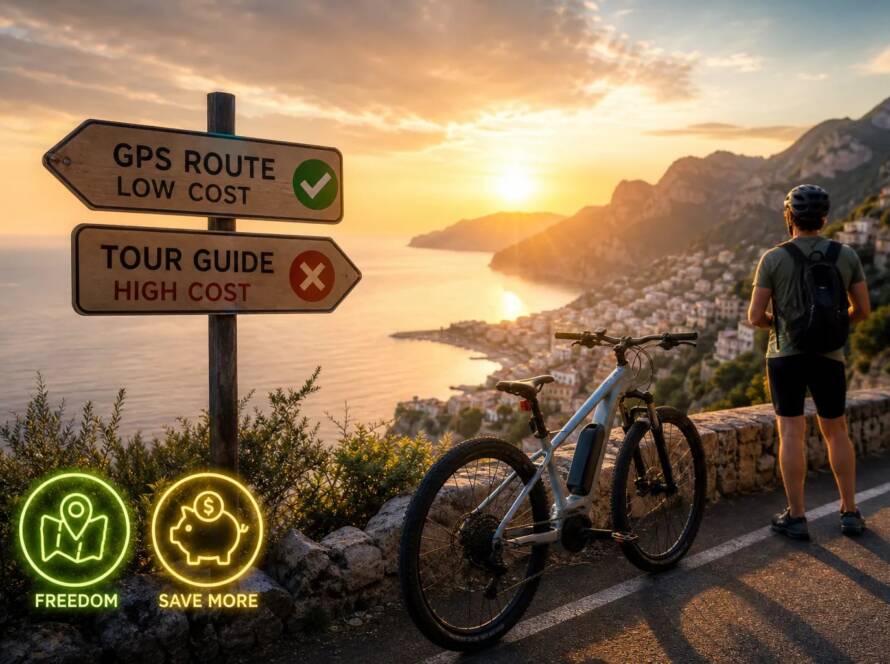
That is the thinking behind the GPS-guided routes we build at Fun E-Bike Adventures. Every route is personally scouted and ridden by our founder before it is mapped, so every turn, surface change, and point of interest is documented by someone who already had that “oh, that bend is sharper than it looks” moment for you. Riders arrive at each section with a mental model already loaded, which means more of their attention goes toward enjoying the ride instead of processing surprises. Routes start under $6 and live on your device forever, no expiration date.
Does riding this way actually reduce crashes?
The honest answer is: the evidence is promising, and the mechanism is logical, but the research has limits you should know about. The NCBI hazard-prediction study of Chinese cyclists found that crash-involved riders consistently scored lower on prediction tests than riders with no crash history, with a meaningful correlation between lower prediction ability and more crashes over the previous two years. Separately, a randomized study of 66 e-bike riders conducted at Delft University of Technology found that hazard-anticipation training produced faster hazard responses and more frequent decisions to slow at dangerous intersections.
The credible causal pathway runs like this: anticipate earlier, identify conflict sooner, brake or reposition earlier, and reduce the chance of the conflict becoming a crash or near-miss. That chain of logic is solid. The gap in the research is that most studies measure skills and behaviors rather than counting actual crashes before and after training, so direct proof of crash reduction remains thin.
What the evidence actually shows (and what it doesn’t)
The strongest finding is the association between lower hazard-prediction ability and crash involvement. That association is meaningful and consistent enough to take seriously. What the research does not yet show is a clean, large-scale study tracking riders through training and then counting crashes over years. Be skeptical of anyone who claims predictive riding is a guaranteed crash-prevention system; the data is not there yet for that claim.
What predictive riding can’t do (and why reactive skills still matter)
Anticipatory riding reduces how often emergency reactions are needed. It does not eliminate the need for them. Snap braking, emergency swerves, and quick body-position adjustments are still your last line of defense. Predictive cycling is not about riding fearlessly; it is about maintaining a cushion of options so that the last-resort skills stay exactly that: last resort, not first response.
How to adjust your scanning game for different terrain
The SIPDE loop runs in every environment, but what you scan for changes completely depending on where you are riding. Urban streets require predicting human decisions. Suburban roads demand longer sight lines and respect for hidden speed. Trails require predicting terrain and traction, not just other people. Defensive cycling habits matter in all three settings, but the specific cues shift with every change in terrain.
| Environment | Main prediction target | Key adaptation |
|---|---|---|
| Urban streets | What people and vehicles will do next | Door zone awareness, steady positioning, short-range scanning, conspicuity |
| Suburban roads | Hidden road users and speed changes | Longer sight distance, extra following space, early speed reduction at crests |
| Off-road trails | Terrain, traction, and the bike’s response | Early line choice, flexible body position, smooth control inputs |
Reading streets and suburban roads with anticipatory eyes
In urban settings, the main hazards are human decisions: turning vehicles, opening doors, bus stop activity, pedestrians mid-scroll on their phones, and delivery trucks double-parked in the lane. Stay out of the door zone, approach bus stops ready to slow, and hold a steady, predictable line rather than weaving. Suburban roads feel quieter but are often more dangerous because lower traffic density produces higher vehicle speeds and less driver attention. Treat every blind crest and every driveway hidden behind a hedge as a potential conflict, and build in extra following distance behind any vehicle that might turn or stop unexpectedly.
Trail-specific anticipation: terrain, traction, and other trail users
On trails, you are not only predicting what other people will do; you are predicting what the surface will do to your bike. Gravel patches around blind corners, ruts that redirect your front wheel, wet roots, and trail narrowings after a downhill speed build all require a different kind of attention. Look through corners at the trail exit, not at the obstacle directly in front of you. Identify surface texture changes early, choose your line before you reach the tricky section, and reduce speed while you are still upright and in control, not while you are already in the middle of the problem.
Shared trails add the human layer back in. Pedestrians with dogs on retractable leashes, oncoming riders who drift to the center, and small children who change direction without warning all require the same SIPDE loop you use on a street, applied to a much narrower space. Slow before blind curves, communicate before passing, and never assume a warning signal alone is enough to clear a path.
Three drills to build predictive riding skills without traffic
You do not practice anticipatory riding in rush-hour traffic. You build the skill in low-stakes settings and then bring it into real conditions. An empty parking lot, a quiet path, or a closed cul-de-sac works perfectly. Start at walking speed, increase complexity before you increase speed, and keep a helmet on regardless of how slow you go.
The 20-second hazard scan and “what happens next?” commentary drill
Set a mental timer: every 20 seconds, name three possible hazards aloud and state your planned response. “Parked car on the right, I’ll move out. Pedestrian near the curb, I’ll cover the brake. Surface looks wet ahead, I’ll reduce speed now.” The act of verbalizing forces the scan-evaluate-execute habit into a conscious loop, which is exactly where you want it before it becomes automatic.
On a familiar low-risk route, run the commentary drill continuously: narrate what you see, predict what it might do, and state how you will respond before the situation develops. Researchers specifically recommend this narration approach as a way to build road-reading skill, and it works precisely because it prevents the mind from skipping the “predict” step under the pressure of real riding.
Cornering circuit and obstacle-avoidance progressions for proactive bike handling
Set out cones to create a series of wide turns. Before each corner, identify the exit, reduce speed while you are still upright, look through the bend at the exit point (not at the cone), and follow an outside-inside-outside line. Repeat with different entry speeds, but never faster than you can control comfortably. For obstacle avoidance, place flat markers on a smooth surface, steer around one smoothly, return to your original line, then prepare for the next marker on the opposite side. The goal is a smooth, predictable line change, not a fast one.
A second variation uses group riding to retrain the reactive habit. Ride single file in a traffic-free area at a steady following gap. The lead rider makes gradual speed changes; following riders read body language and gap changes rather than waiting for a wheel to slow in front of their face. When you can feel a deceleration before you see it, you have built genuine anticipatory awareness, and that awareness transfers directly to real-world riding.
Start where you are, look farther than you did yesterday
Understanding what it means to ride a bike predictively, and why it matters, comes down to this: predictive cycling makes you the rider whose smooth, early adjustments leave other trail users wondering why nothing ever seems to catch you off guard. It is not a reflex you are born with; it is a practiced skill built from scanning, predicting, and acting before problems arrive rather than after. Drill the scan pattern in a parking lot. Run the commentary habit on a route you know well. Choose familiar routes that let you build a mental model before you build speed.
Every ride you take is a practice opportunity, whether you are on a well-worn neighborhood path or exploring a new destination. The more you know what is coming, the more mental bandwidth you free up to actually enjoy where you are. And when you are riding a well-scouted route on a properly mapped trail, that mental preview is already loaded before you even clip in.
Start by looking a little farther down the trail than you did on your last ride. That is the whole thing, right there.
Frequently Asked Questions
How is predictive riding different on an e-bike compared to a regular bike?
Predictive riding on an e-bike requires looking farther ahead and allowing more stopping distance because e-bikes are heavier and travel faster. We recommend aiming for a minimum visual lead of 20 to 30 meters (roughly 65 to 100 feet) at typical e-bike speeds, and increasing that distance near junctions, blind bends, and high-traffic zones.
Will predictive riding remove the need for emergency braking or sudden maneuvers?
No, predictive riding reduces how often emergency reactions are needed but does not eliminate the need for them. We still advise practicing snap braking and quick body-position adjustments as last-resort skills while using anticipatory habits to keep those moments rare.