So, what is the best way to plan a group e-bike trip? Build the entire plan around your least experienced rider, assign clear roles before anyone clips in, and solve navigation before the ride day so the group stays focused on having fun instead of arguing about turns. Do those three things, and you have already addressed most of what causes group rides to fall apart.
Here is what actually happens on most group e-bike trips that go sideways: mixed skill levels create a pace nobody agrees on, battery anxiety sets in after the first big climb or once riders notice unexpectedly high consumption, and the person who said “I’ll just navigate from my phone” is now staring at a Google Maps screen while everyone waits at a trailhead. The fix is not luck. It is a plan. Remove navigation as a variable entirely, assign the right people to the right roles, and do the battery math before the day-of chaos starts. The sections below walk you through exactly how.
Key takeaways
- Plan for the weakest link: Design your route around the least experienced rider, the shortest battery range in the group, and the slowest comfortable pace. Everyone else will be fine.
- Solve navigation in advance: Pre-built, GPS-guided routes loaded on every rider’s phone before departure eliminate the biggest source of group-ride stress.
- Assign five roles: Ride leader, sweep rider, mechanical lead, first-aid lead, and emergency contact coordinator. Name them out loud before anyone pedals.
- Reserve 20-25% battery: Never plan to arrive empty. Build in a buffer for detours, headwinds, and unexpected climbs.
- Book rentals early: Popular e-bike models sell out, especially on weekends. Contact rental companies directly for group reservations.
- Run a pre-ride briefing: A short morning briefing with a 5-minute test loop catches mechanical problems and bike-fit issues before they become mid-route emergencies.
How do you pick the right route when planning a group e-bike trip?
The golden rule: design the route for the person who has never done this before, the bike with the shortest battery range, and the slowest pace that keeps everyone comfortable and smiling. Every other rider can handle easier. Nobody can handle harder than their limit.
When evaluating a route, check total distance, cumulative elevation gain, surface type (paved beats gravel for mixed groups), traffic exposure, and access to restrooms and food. Prefer loops or out-and-back routes with multiple bailout points built in. Long stretches with no exit options are a liability when someone’s battery starts looking nervous or a rider just needs to call it. Also confirm that the e-bike classes in your group are actually permitted on every trail or road segment you plan to use, regulations vary by location, and getting turned around at a trailhead is a special kind of miserable.
Why pre-scouted routes make a difference
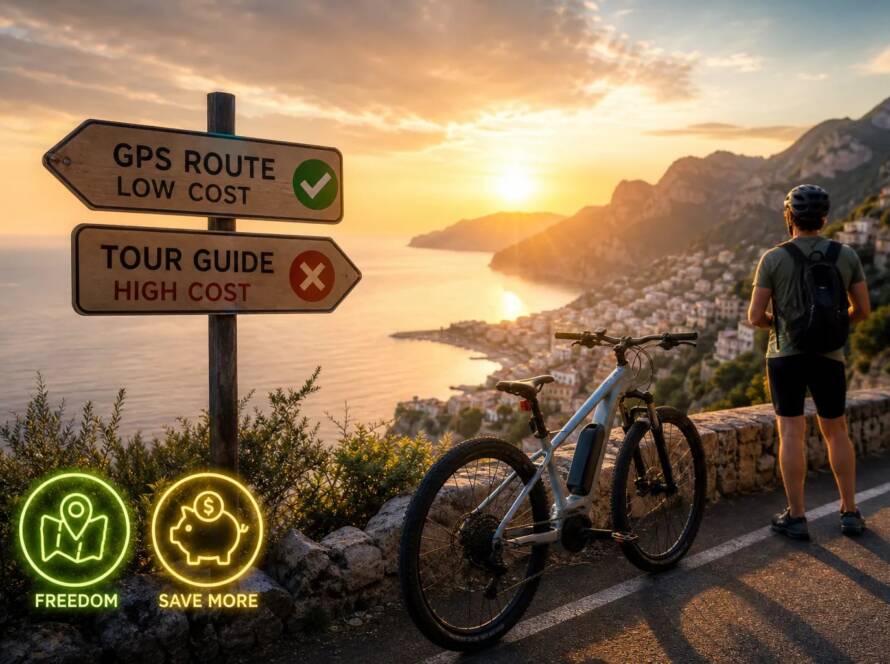
Planning a custom route from scratch for a group takes hours. A pre-scouted route eliminates that entirely. At Fun E-Bike Adventures, every route is personally ridden and verified by founder Chris Jameson, with turn-by-turn navigation and points of interest baked in, the kind of insider detail no generic map app provides. Routes run on the Ride with GPS platform, so every rider in the group can load the same track on their phone before leaving home. Routes start under $6 with no expiration date once downloaded.
How do you calculate battery range for group e-bike trip planning?
The range number on the spec sheet assumes flat terrain, a light rider, Eco mode, and zero wind. Your group ride will involve none of those things simultaneously. Plan around real-world numbers instead.
Here is a practical reference by battery size under flat versus hilly conditions (ranges based on aggregated guidance from BikeTips and BikeExchange):
| Battery capacity | Flat terrain, low-moderate assist | Hilly terrain, moderate-high assist |
|---|---|---|
| 250 Wh | 25-40 miles | 15-25 miles |
| 500 Wh | 45-70 miles | 25-45 miles |
| 750 Wh | 65-100 miles | 40-65 miles |
Hills are the biggest drain. According to BikeTips, a route with roughly 1,000 feet of climbing can reduce range by about 20-30% compared with a flat route. Turbo and Boost modes can use roughly three to four times as much power as Eco mode, so use them for climbs and save Eco for the flat sections. (Spoiler: headwinds never check your battery level first.) Build the entire charging plan around the rider with the shortest practical range, not the biggest battery in the group.
Placing charging stops strategically
For charging stops, the rule is simple: place them before the longest climb, not just at the most convenient café. Verify that outlets are actually available and that the business permits charging. A 20-25% battery reserve is non-negotiable. That buffer covers detours, headwinds, and the inevitable moment someone overshoots a turn and adds an unplanned mile. Require every rider to start fully charged and carry their charger if mid-ride charging is part of the plan.
What group roles should you assign before the ride?
Five roles, name them out loud before anyone pedals, or you end up with eight people quietly assuming someone else is handling it.
- Ride leader: Sets the pace, calls turns, monitors the group ahead, and adjusts the route when conditions change.
- Sweep rider: Stays at the back, confirms no one is left behind, and relays problems forward to the leader.
- Mechanical lead: Carries or coordinates tools, spare tubes, a pump, and chain repair supplies.
- First-aid lead: Carries the kit, knows who has relevant training, and handles any medical situation.
- Emergency contact coordinator: Holds the full itinerary, participant contact list, and bailout procedure.
For groups larger than six, split into smaller pods. Each pod gets its own leader and sweep with a visible gap between units. Consider adding a middle assistant between the leader and sweep to catch mid-pack riders who silently fall behind, mid-pack silence is how people get left at intersections. Each sub-group carries its own tools, first aid, and emergency information. Never assume one kit serves everyone spread across a half-mile of trail.
What riding rules keep a mixed-ability group safe and together?
Set a target moving speed the slowest rider can sustain comfortably. For beginner or heavily mixed groups, 8-10 mph is a reliable planning pace. Here is a quick reference for the full range (pace guidance aggregated from BikeTips and BikeExchange):
| Ride type | Target moving pace | Planning average including stops |
|---|---|---|
| Beginner, hilly, or heavily mixed ability | 8-10 mph | 6-8 mph |
| Moderate recreational road or trail ride | 10-14 mph | 8-11 mph |
| Strong, experienced, well-matched group | 14-18 mph | 11-15 mph |
Maintain at least two seconds of following distance. Avoid race-style drafting unless every person in the group is trained for it. Ride single file on narrow, winding, or busy roads. Two abreast is only acceptable where it is both legal and genuinely safe, not just where it feels convenient.
Agree on consistent hand signals and verbal calls before departure, and make sure every rider relays calls toward the rear. Common ones to agree on: “Stopping,” “Slowing,” “Left/Right,” “Hole” or “Gravel” for surface hazards, “Car back,” and “Single file.” For e-bike groups, add “Ease up” for reducing pace, “Mechanical” for an unscheduled stop, and “All on” when the last rider has rejoined. Every rider relays every call. Strongly encourage this as a non-negotiable habit, relayed calls are how the back of the group survives the same intersection as the front.
The group waits at every designated regroup point, full stop, no exceptions. If a rider becomes separated, stop at the last known point, call or message, and do not send an isolated rider searching alone. Regroup at spacious, visible spots off the travel lane, not mid-trail where the group becomes an obstacle for everyone else.
How do you handle rentals, gear, and the day-of briefing?
Reserve bikes at least one week ahead. Popular models sell out, especially on weekends and holidays. Contact the rental company directly for group reservations rather than booking online. Ask specifically about per-bike deposits, group minimums, delivery options, helmet availability, and whether helmets are included. Many companies offer roughly 10-20% off for groups beginning at four to eight bikes, though those discounts are typically handled case by case rather than advertised publicly, confirm the terms directly when you call.
Expect each rider to need a valid photo ID and a signed liability waiver. The booking lead is typically responsible for every bike in the group, which means someone gets a very awkward phone call if a bike comes back damaged. Clarify the cancellation and weather policy before paying any deposit. Get the terms in writing.
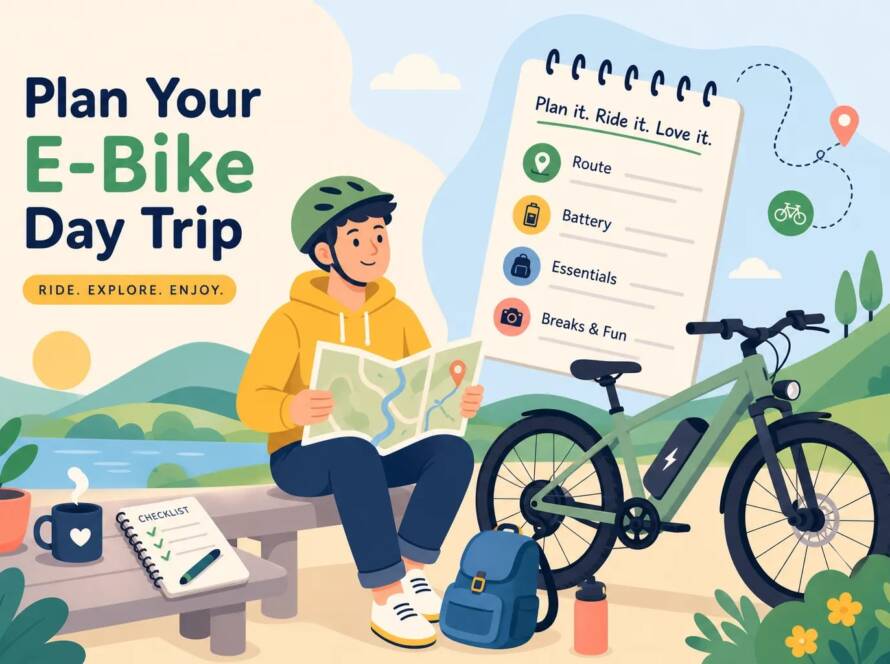
The day-of briefing is where the plan either holds together or quietly starts unraveling. Send one clear trip brief to every participant before the ride day: meeting point, parking, departure time, route map or downloadable track, distance, elevation, pace, and charging stop locations. On the morning of the ride, run a quick bike check covering helmet fit, tire pressure, brakes, lights, battery charge, and phone loaded with the route offline. Introduce the leader, sweep, first-aid lead, and mechanical lead by name before anyone pedals. Then take a short 5-minute test loop near the meeting point. A brief test ride like this regularly catches mechanical issues, fit problems, and control unfamiliarity before they become mid-route headaches, well worth the five minutes before committing to the full route.
Now go ride something worth remembering
So what is the best way to plan a group e-bike trip? The framework is straightforward: plan for the least capable rider, handle navigation before the ride day, assign roles, communicate the rules, and build a buffer into both the battery plan and the schedule. Do all five and you have a group ride. Skip two of them and you have a group argument that happens to take place outside.
When the route is already mapped, verified, and loaded on everyone’s phone, your group stops managing logistics mid-ride and starts actually riding together. That shift, from navigator to participant, is what turns a stressful outing into a genuinely memorable one. For groups across the U.S. looking for a route that is already scouted, verified, and ready to go on Ride with GPS, Fun E-Bike Adventures routes handle that entire piece for under $6 per download, with no expiration and no guide tip required.
Planning a group e-bike trip well is genuinely achievable. The hard part is not the riding, it is the 48 hours before the ride. Nail the electric bike group ride checklist, load the route, and the rest takes care of itself.
Frequently Asked Questions
How early should we reserve e-bike rentals for a group ride?
You should reserve bikes at least one week ahead. Popular models sell out, especially on weekends and holidays, so contact the rental company directly for group reservations and confirm deposits, helmet availability, and any group discounts.
What should the booking lead be prepared for regarding liability and fees?
The booking lead is typically responsible for every bike in the group and may need to handle charges if a bike is returned damaged. Confirm per-bike deposits, group minimums, cancellation and weather policies, and get the terms in writing before paying any deposit.
How do we manage groups with different battery capacities on the same trip?
Plan the entire charging strategy around the rider with the shortest practical range, not the biggest battery in the group. Require every rider to start fully charged, carry chargers if mid-ride charging is planned, place charging stops before the longest climb, and always build in a 20–25% battery reserve.
What must be included in the day-of briefing to avoid mid-route problems?
The day-of briefing should cover helmet fit, tire pressure, brakes, lights, battery charge, and that each phone has the route loaded offline, plus introductions of leader, sweep, first-aid lead, and mechanical lead by name. Also send a clear trip brief beforehand with meeting point, parking, departure time, route map or track, distance, elevation, pace, and charging stop locations, and run a short 5-minute test loop before committing to the full route.